I’ve tested dozens of varieties – these are the 12 best hot weather plants for a spectacular summer display even during a heatwave
Growing climate-resilient plants will make life easier and give you more time to enjoy the weather (while it lasts!) in your garden

Does hot summer weather make the plants in your garden wilt? In a hot summer, it is easy to spend most of the time watering just to keep your garden plants happy.
Growing climate-resilient plants will make life easier and give you more time to enjoy the weather (while it lasts!) in your garden.
We have pulled together the top hot-weather plants that thrive in a warm summer, coping well with soaring temperatures.
The best hot-weather plants that thrive in a warm summer
1. Salvia nemorosa ‘Cardonna’

Salvias are some of the best perennials for surviving the hot summer sun. ‘Cardonna’ is, therefore, one of the best of the best with dazzling deep purple flowers that top dark stems. They’re incredibly aromatic too, and so a lovely plant for borders near patios or benches, so you can really make the most of the scent. It will bloom from early summer into autumn for a delightfully long display.

Plant ‘Cardonna’ in full sun and well-drained soil. It’s a Royal Horticultural Society (RHS) award-winning plant and will look simply splendid in cottage garden borders.
2. Rosa ‘Tottering by Gently’

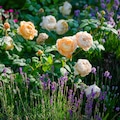
Rosa ‘Tottering by Gently’ will continue to produce the most spectacular flowers between June and September in the hot weather. It’s a pollinator favourite, so if you’re keen on designing a wildlife-friendly garden, this would be the rose to choose. In later seasons, the bright flowers will develop into the most beautiful rosehips. Introduced in 2018 by David Austin, it has a light honey fragrance.
This English Musk Hybrid rose will reach approximately 1.3m in height and is perfect for informal hedging or incorporated into a mixed perennial planting scheme. I think it’s soft buttery petals work wonderfully alongside the deep purples of the best lavender varieties.
3. Cosmos bipinnatus ‘Purity’
.jpg?imwidth=1440)
Cosmos really love hot, dry summer weather, and often you will see more abundant flowering than you would in moist, rich soil, which makes Cosmos bipinnatus an exceptional choice for warm conditions. I adore the pretty white blooms, with their delicate, almost paper-like petals. Pollinators are big fans too, and this is an ideal plant for bees.

It’s sensible to dead-head Cosmos bipinnatus ‘Purity’ regularly to increase the amount of beautiful blooms and lots of gorgeous feathery foliage.
4. Eryngium ‘Big Blue’

‘Big Blue’ will form mounds of ice grey spiny leaves that are perfect for adding texture to a border. Large thistle-like flowerheads of cobalt blue sit above a ruff of silvery bracts that sit high above the foliage on thick, blue-tinted stems. It works brilliantly as a cut flower and dries well for longer-lasting displays.

A semi-evergreen perennial, Eryngium will thrive in poor to moderately fertile soil, so long as it is well-drained, and positioned in full sun. When spring arrives, you can trim the stems for fresh growth, but in winter, they can be left to add texture and interest.
5. Agapanthus ‘Navy Blue’

Agapanthus ‘Navy Blue’ sports bountiful bells of the deepest blue on arching stems that are tinted with midnight hues. It is a dramatic, bold agapanthus that will bask in the sun’s rays and works equally well in a container, if not better, because the more its roots are restricted, the better it performs. ‘Navy Blue’ produces flowers from July until September.

Agapanthus adore full sun, and this variety is no exception. It’s fully hardy and promises to do well in the majority of soil types. It will grow to a height of 60 to 120 cm and spread to 45 to 75 cm.
6. Cynara scolymus (globe artichoke)

As bold as it is beautiful, globe artichokes are loved by insects. It loves full sun but is not keen on wind, so a sheltered site is recommended. Its architectural grey-green leaves sprout in February, providing early interest, but it’s the height and stature of the plant that earns it a place in the border. The flowerheads are the size of a fist and open to thistle-like purple flowers from summer to autumn. Their cottony seed heads also provide great nesting material for birds.

Globe artichokes thrive in fertile, well-drained soil enriched with compost or well-rotted manure before planting. In heavy soils, add grit to improve drainage and prevent waterlogging. Water thoroughly after planting and keep the soil consistently moist until plants are well established. You can harvest artichokes from the second year onward, cutting tight buds before they open, and be sure to divide mature clumps every four to five years.
7. Lavandula angustifolia ‘Hidcote’

All lavenders thrive in hot, sunny conditions. This lavender has highly aromatic foliage and deep purple flowers. It is perfect for sun-soaked days in summer when its flowers stand proud above its leaves. It’s also great in flower arrangements and good for drying too.

One of the most popular varieties of English lavender, and for good reason. It’s aromatic, compact, and neat, with the most intensely purple flowers.
8. Erigeron karvinskianus

This daisy-like perennial should be welcome in any garden. It gently spreads and populates unsightly nooks and crannies with masses of delicate daisy-like flowers over an incredibly long flowering period, from late spring into autumn. The flowers blush demurely as they age, turning pink with their winking central eye. They are good for encouraging bees and butterflies, and thrive most when savouring the sun’s rays.

Commonly known as Mexican fleabane or Santa Barbara daisy, Erigeron karvinskianus is a long-flowering perennial that brings effortless charm to gardens from late spring to autumn. Growing 30–50cm tall, it will spread up to 1m, and is therefore ideal for walls, borders, pathways, and containers.
9. Sedum

A dreamy plant for hot weather because its fleshy, succulent leaves store water and therefore help it withstand extended dry periods. This hardy perennial thrives in full sun and poor, well-drained soil, requiring very little maintenance once established. From late summer into autumn, it produces large clusters of pink, red, or cream flowers that attract bees and butterflies. Sedum’s drought tolerance makes it ideal for gravel gardens, borders, and containers, while its architectural form provides interest throughout the year, even after the flowers have faded.

Flowering between August and October, pop Hylotelephium ‘Matrona’ in a sunny border in moderately fertile, moist, well-drained soil and enjoy joyous interest across the seasons.
10. Verbena bonariensis

With an impressive tolerance of heat, drought, and full sun, the tall, slender stems topped with clusters of vibrant purple flowers that bloom continuously from midsummer into autumn are a sight to behold in the garden. Verbena has a deep root system that ensures it can gather moisture during the dry periods, so it is a low-maintenance choice too. Pollinators love its rich nectar.

A remarkably graceful perennial that boasts such a long flowering season, it can reach 2m and produces clusters of vivid purple blooms that appear to float above surrounding plants. Flowering from summer into autumn, it brings structure and movement to mixed borders, cottage gardens, and naturalistic planting schemes.
11. Perovskia

If you have poor soil, then Perovskia is a reliable choice for drought resistance and will thrive in harsher terrains. I adore the lavender blue flowers that bring brightness and a lovely aroma to the garden. The foliage reduces water loss and also helps as a pest deterrent.

A striking late summer perennial that, between August and September, will produce clouds of small violet-blue tubular blooms that rise above grey-green leaves. It is ideal for drought, chalky soils, and coastal conditions; it performs best in open, well-drained sites.
12. Gaura

Lauded for its ability to flower continuously through hot, dry summers, Gaura provides beautiful naturalistic planting and months of colour in early summer through until autumn. Its blooms are delicate and eye-catching amongst green foliage.

From late spring through early autumn, Oenothera lindheimeri produces delicate white, star-shaped flowers with long, slender stamens on wiry stems, creating a soft effect. Its naturalistic habit suits cottage gardens, prairie-style planting, and contemporary borders and once established, it is highly drought-tolerant and thrives in full sun and well-drained soil.
When plants do require watering during periods of hot weather, having the best watering kit and watering tools is paramount. For a decent garden hose, try the Hozelock Superhoze, 30m from Amazon, or the Gardena Comfort HighFlex Hose, 30m from Amazon, whilst the best watering cans include the Elho recycled plastic watering can from Amazon and The Cradley Cascader from Haws.

d010.jpg?imwidth=320&impolicy=utilities-thumbnail)
More from The English Garden


6138.jpg?imwidth=320)